Why who turns up at the door is everything.
The carer who walks into your home is the person who matters most. Here’s a bit about ours, and the choices we’ve made over nearly six decades to build the team we have.
Speak to us0118 334 7474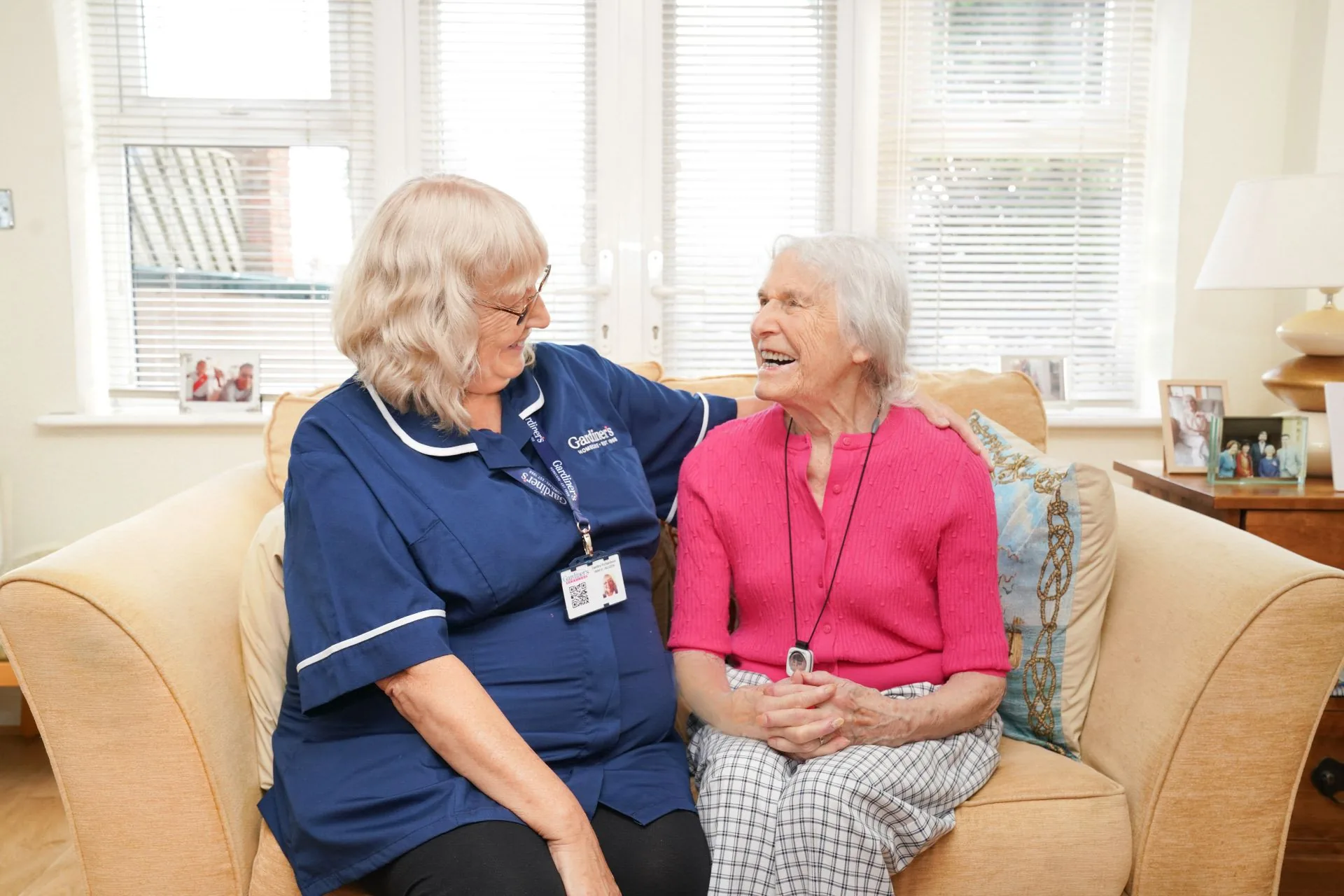
Five things we’ve chosen to do — and how it shows up in the home.
A few of these have been part of how Gardiner’s works since the beginning. A few have come more recently. None of them are dramatic on their own; together, they’re a fair description of the team we have.
The same carers, year after year.
The average tenure of a Gardiner’s carer is over eight years. Several have been with us for twenty, and a few for thirty.
What that means in practice is that the carer who arrives at your mother’s door this Wednesday is likely to be the same one knocking next Wednesday, and the Wednesday after that. Routines don’t have to be re-explained. Small changes don’t go unnoticed. Trust has time to build.
Hired locally. Always have been.
Every carer we employ lives within a few miles of the clients they visit — in Caversham, Pangbourne, Henley, Reading and the surrounds. We’ve always recruited this way and have never held a visa sponsorship licence.
The practical effect is twofold. The vast majority of our team are native English speakers, and the few who aren’t are assessed in writing before we hire them. And because they’ve grown up around here, they share a cultural shorthand with the people they care for — the same shops, the same buses, the same memories of how the high street used to be. Conversation tends to flow.
Trained in person, on the real equipment.
All of our training is done in-house, in person, at our own centre in Pangbourne. We cover considerably more ground than the regulator’s mandatory minimum, and we do it ourselves rather than outsourcing it.
The centre is set up with the full range of equipment a carer might come across in a client’s home — hoists, slide sheets, beds, mobility aids — so by the time someone is visiting, they’ve already practised. Refresher training is a regular part of life here, not a one-off when somebody joins.
Hired carefully.
We hire a small fraction of the people who apply to work with us. The process is deliberately slow — multiple interviews, references, observation in the field, and full training before any solo visits.
That’s a big part of why our team stays. The people who join us tend to be the ones who’ve thought hard about whether this is the work they want to do, and they find a place that takes it as seriously as they do.
Paid well.
Our carers are among the best-paid in home care, with proper sick pay, holiday and pension. We think this is the right way to recognise skilled work, and it’s a meaningful part of why people choose to stay with us as long as they do.
For families, the practical effect is the same as everything else on this page: the carer at the door is someone who’s been doing the job for years, and intends to be doing it for years to come.
Our regular carer, who attended throughout, was a great source of comfort to our sister with her cheery personality.
What families ask us about our carers.
How are carers matched to a particular client?
Matching is something we take seriously and do by hand. After the free home assessment, the care manager who visited will think about which of our carers is the best fit — based on the practical care needed, but also on personality, interests, and the simple geography of where they both live.
The aim is a small team of two or three regular carers who suit the client and the family. Most matches stick. When they don’t, we change them — no awkwardness, no fuss.
What if my loved one doesn't get on with their carer?
Tell us, and we’ll change it. There’s no obligation to give a reason, and there’s no penalty. A carer who isn’t the right match for one client may well be exactly right for another, so it’s rarely a problem — just a question of finding the right pairing.
We’d much rather hear about a small irritation early than have it grow into something worse.
Are your carers DBS-checked and properly vetted?
Yes. Every carer holds an enhanced DBS certificate that we keep up to date, and we take up at least two references — including one from any previous care role — before anyone is offered a job. They don’t see a client until that’s all in place and they’ve completed our training.
Will I always know who is coming?
Yes. You’ll have a published rota in advance with the names of the carers visiting. If something has to change — illness, an emergency — we let you know who is coming instead, and where possible the cover comes from inside your small regular team rather than someone you’ve never met.
How are carers supervised once they're visiting?
Carers are employed and managed by us, not subcontracted. Care managers carry out regular supervisions, spot checks at clients’ homes, and review every care plan on a set schedule. Visit notes are kept after every visit, and any changes in a client’s condition are flagged the same day.
We’re also regulated by the Care Quality Commission, which inspects how we recruit, train and supervise our team. Both our branches are rated Good.
Want to know more about who would be visiting?
We're happy to talk through how we hire, train and look after our carers in any level of detail you'd find useful. No script, no pressure — just an honest conversation.
Mon–Fri 7:30am–5pm · Out of hours, leave a message and we’ll call back.