A trusted carer, living alongside you.
For families who’d rather not move a loved one into residential care, live-in offers round-the-clock support in the place that already feels like home. Carefully matched, expertly trained, there for the long term.
Speak to us0118 334 7474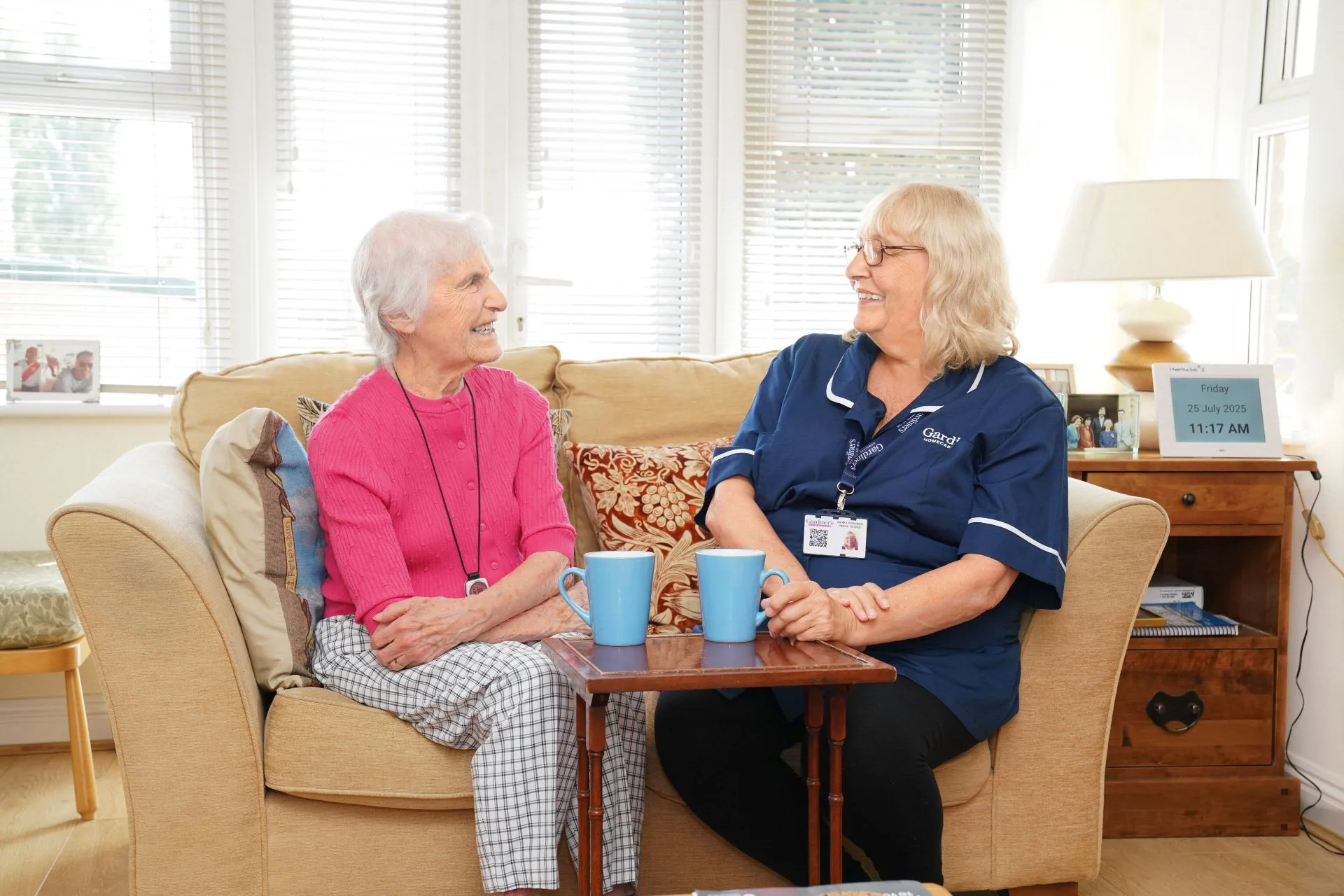
A carer who lives in the home, looking after one person around the clock — for as long as they’re needed.
Live-in care means a carer moves into the home full-time, with their own room, and is on hand throughout the day and night. They cook the meals, help with washing and dressing, manage medication, drive to appointments, sit and chat in the evenings, and are within earshot if anything happens during the night.
For most families, the comparison they have in mind is residential care — a care home. Live-in is the alternative: same level of round-the-clock support, but in the bedroom someone’s slept in for thirty years, with their own kitchen, their own garden, and their own pace.
Carers work in pairs on a rota — one carer with the client for a stretch of weeks, then another takes over while the first has a break — so there’s always continuity, and no carer is ever working without rest.
The things visiting care can’t quite do.
Most of what live-in carers do, hourly carers can do too. The difference is what becomes possible when someone is simply there — not arriving and leaving, but present.
A proper rhythm of meals, walks, and downtime — on the client's schedule.
- Breakfast at the time it's wanted, not the time the rota allowed
- A proper cooked lunch and supper from scratch
- Time for a walk, a drive, a coffee out
- Familiar television, conversation, or quiet — whichever suits
- An afternoon nap whenever it's wanted
Someone in the house if anything happens between bedtime and breakfast.
- Help to the toilet, every time it's needed
- Reassurance through confused or anxious moments
- Falls noticed and responded to within seconds
- A familiar voice, not a stranger arriving
- Family can sleep, knowing nights are covered
Getting out the door and back again, on terms that suit you.
- The weekly shop, with company and a hand at the till
- GP, dentist, optician, hospital appointments
- Lunch at a favourite café, the hairdresser, the bank
- Church, club, family gatherings
- The garden, the park, the river
A relationship with depth, not a procession of new faces.
- The same small carer team, week after week, year after year
- Routines learned properly, preferences remembered
- Health changes spotted early, before they escalate
- Family kept genuinely informed by people who know
- Real friendships often form — and we welcome that
Most often chosen as the alternative to a care home.
Some of our live-in arrangements have been in place for many years — the same carers, the same family, a steady rhythm of life at home. Others are shorter, helping someone through a specific period before things change again. Both are equally what we do.
For families where help is only needed at certain points in the day, hourly visits often make better sense — carers who arrive, do what’s needed, and leave. We’ll always say honestly which fits your situation.
- 01
Instead of moving into residential care
The most common reason families come to us. Care needs have grown, but the thought of leaving home is unthinkable. Live-in offers the same level of support without the move.
- 02
Living with dementia
Familiar surroundings are particularly important in dementia care. A carer who learns the home, the routines and the person can keep things calm in a way a residential setting often can't.
- 03
Couples care
When one partner cares for another and it's become too much — or when both need support — a single live-in carer can look after the household. Often the most cost-effective way of keeping a couple together at home.
- 04
End-of-life care at home
Where someone wishes to die at home, live-in care provides the round-the-clock presence that makes it possible — working alongside district nurses, hospice teams and the GP.
- 05
Recovery from illness, injury or hospital
A few weeks of live-in care after a fall, a stroke or a hospital stay can be the bridge that gets someone back on their feet at home, rather than into residential care by default.
- 06
Respite for a family carer
If a husband, wife, son or daughter has been doing the caring and needs a real break — a holiday, an operation, simply some recovery time — we offer respite live-in care from a fortnight upwards.
A specialist branch, not a sideline.
Live-in care is a different discipline from visiting care. We run it as a separate, CQC-registered branch from our offices in Pangbourne, with a manager and team dedicated to it.
Carefully matched.
Living with someone is more intimate than visiting them. We take the time to match each client with a carer whose personality, interests and approach genuinely fit — and we’ll change things if a match isn’t working.
Trained for complex needs.
All our carers train in person at our centre in Pangbourne, on the full range of equipment and conditions they’ll encounter — from manual handling and dementia to stoma care, catheter care and end-of-life support. The training is the same whether they’ll be visiting hourly or living in.
Cover that holds steady.
Carers work in rotation so they get proper rest. When the regular carer takes their break, the same replacement covers each time — someone who already knows the client and the household. Two familiar faces, not a parade of new ones.
A weekly fee, set by need.
Live-in care is priced weekly. The exact rate depends on the level of care needed, agreed after a free home assessment. No setup fee. To end an arrangement we ask for 28 days’ notice, although you can cancel at any time within the first 14 days of care starting.
- A dedicated, expertly-trained carer
- Free home assessment and care plan
- Cover when the regular carer is on break
- Ongoing care management and supervision
- Carer accommodation in the home
Mum’s wellbeing has improved considerably… the enrichment facilitated by her carer taking her to new places and community events has enhanced mum’s quality of life exponentially.
What families ask us about live-in care.
How does a carer get a break if they're living in?
Carers work in rotation. The regular carer will typically stay for a stretch of weeks, then a second carer takes over while the first goes home for a proper rest period. The two work as a pair on the same client, so both become familiar faces.
Within each working day the carer also has agreed break times — usually a couple of hours when the household is settled — for their own meals, errands, or simply some quiet. Family or a brief visit from a second carer covers if needed.
What does the carer need from the home?
Their own bedroom, with a comfortable bed and somewhere to keep their things, is the main requirement. Access to a bathroom, kitchen, and somewhere to relax in the evening — ideally not the same room the client uses to wind down — works well.
Households also cover the cost of the carer’s food and any utilities used. We’ll talk you through the practicalities at the assessment.
Is live-in really cheaper than a care home?
For one person, live-in care and good residential care are usually similar in weekly cost — people choose live-in mainly because of staying at home, not for savings.
For a couple, live-in is often significantly cheaper than two places in a care home, because one carer can look after both. We’re happy to talk through specific numbers for your situation.
Can a live-in carer manage complex medical needs?
Yes, in most cases. Our carers — both live-in and visiting — are trained for stoma care, catheter care, wound dressing, PEG feeding support and end-of-life care, working alongside district nurses and the GP. We’ll talk through specific clinical needs at the assessment so the right plan is in place from day one.
Can you provide care for a couple?
Yes — couples care is something we do regularly. One live-in carer can usually look after both partners, provided the level of need is manageable for one person. For more demanding cases we’ll arrange two carers in rotation. Pricing for couples is set individually after the assessment.
Can I book live-in care just for a short period?
Yes. Respite live-in care — from a fortnight upwards — is a regular part of what we do, often booked while a family carer takes a break, recovers from an operation, or goes away. It’s also a useful way to try live-in for a few weeks before deciding on something longer-term.
How quickly can live-in care start?
For most situations we ask for a week or so — long enough to come for a free home assessment, agree a care plan, and select the right carer match. For urgent situations, including hospital discharge or end-of-life, we’ll do everything we can to move faster.
Are you regulated, and how can I check?
Yes. Gardiner’s Live-in Care is a separately CQC-registered branch, based in Pangbourne, rated Good. The inspection report is public on the CQC website, and reviews from live-in clients and families are independently verified on homecare.co.uk.
Wondering if live-in care could work for your family?
A short phone call is usually enough to talk through whether live-in is the right answer, or whether a different arrangement would suit better. No script, no pressure — just an honest conversation about what you're weighing up.
Mon–Fri 7:30am–5pm · Out of hours, leave a message and we’ll call back.